Strychnine
The Mysterious Affair at StylesStrychnine is both the lethal substance in Emily Inglethorp’s death and the material around which the Styles investigation repeatedly revises its explanations. Its bitter taste, dose, timing, and behavior within a medicine mixture make it more than a generic poison: the substance’s chemical properties explain the apparent delay, expose the misleading focus on coffee, and ultimately connect the death to the last dose of a prescribed tonic.
Poison and Investigation
The possibility of poisoning is raised before Emily’s death. Mary Cavendish observes that poisoning may go unsuspected because medical professionals are generally unfamiliar with less common poisons. That remark establishes the case’s central difficulty: a poison may be present without its role being immediately recognized. Later, the investigation settles on strychnine as the substance to explain.
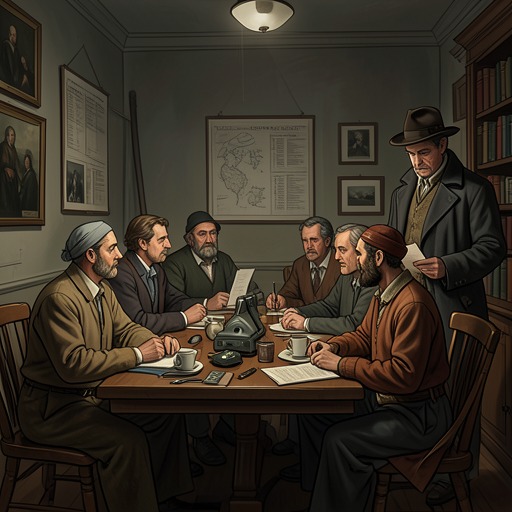
Hercule Poirot initially frames the death as strychnine poisoning, presumably administered in Emily’s coffee, and asks when the coffee was served. That proposed route becomes less secure as the evidence develops. At the inquest, a specialist reports that the post-mortem establishes strychnine poisoning and estimates that Emily took at least three-quarters of a grain, probably a grain or slightly more. Accidental ingestion is considered very unlikely: strychnine is not ordinarily used domestically, and its sale is restricted.
The evidence also gives the poison a distinctive sensory property relevant to the investigation. It is described as so bitter that it can be detected in a solution of one part in 70,000, and as difficult to disguise except with a strongly flavoured substance. Cocoa would not mask it, whereas coffee’s own bitterness could probably conceal it. The contrast helps explain why coffee initially appears plausible, while cocoa can be tested and excluded.
Routes Considered and Evidence Reassessed
The inquest examines both the after-dinner coffee and the cocoa Emily usually drank in the middle of the night. The doctor considers coffee a possible vehicle but notes a timing problem: strychnine ordinarily produces symptoms within one to two hours, while Emily’s symptoms begin in the early hours, well after the coffee was supposedly taken at about eight. The doctor says none of the conditions that might retard the drug appears to have been present. A sample of the remaining cocoa, meanwhile, tests negative for strychnine.
Annie’s account adds a startling but initially ambiguous detail. She noticed what appeared to be coarse kitchen salt on the tray carrying Emily’s nightly cocoa. In a hurry, with Dorcas away, she brushed it off with her apron and took the drink upstairs, thinking the salt might have fallen only on the tray. The narrator recognizes that the material was strychnine, although Annie herself did not know it. That clue does not establish that the cocoa was the fatal vehicle: testing later distinguishes the poison from the cocoa itself and redirects attention to a different preparation.
At one point, Poirot also warns against the unusually neat body of evidence directed at Alfred Inglethorp. If Alfred knew Emily would be poisoned that night, Poirot argues, he would have arranged to be away from the house; his stated excuse for his absence looks fabricated, but that leaves open whether he anticipated the crime or had another reason for being absent. Poirot later judges the evidence against Alfred too conclusive to be natural. In his view, a criminal has manufactured it so elaborately that the effort will defeat itself and allow Alfred to be freed. Strychnine thus becomes part of a trail that must be interpreted, not merely counted.
The Medicine and the Fatal Dose
Poirot’s final account distinguishes the testing of the cocoa for strychnine from testing it for a narcotic. He explains that Mrs. Cavendish had administered a safe narcotic to Emily and Cynthia, and that the analyst commissioned by Dr. Bauerstein had been asked only whether strychnine was present. Poirot’s separate test was for a narcotic. This distinction clarifies how an investigation can obtain a correct result about one substance without answering a different question about the sample.
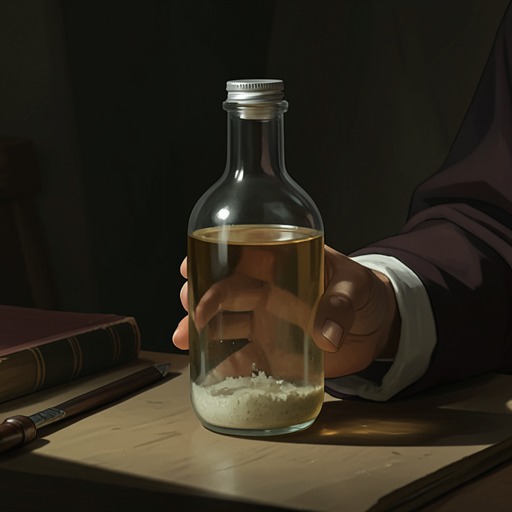
The fatal strychnine, Poirot concludes, was already in Emily’s prescribed tonic; it did not need to be added by the murderer. He supports this explanation with a dispensing text found in the dispensary at the Red Cross Hospital at Tadminster. It describes a mixture in which strychnine salt precipitates over several hours as insoluble bromide crystals. The text recounts a similar fatal case: the precipitate settled at the bottom, and the person taking the last dose swallowed nearly all of it.
Poirot connects that process to an empty box of bromide powders and to Dr. Wilkins’s prescription, which itself contained no bromide. One or two bromide powders introduced into the full medicine bottle, he explains, would cause the strychnine to precipitate. The person who usually poured out Emily’s medicine was careful not to shake the bottle, leaving the sediment undisturbed until the final dose. The crucial mechanism is therefore not simply poison placed in a drink: it is the settling of the poison into a concentrated residue and its eventual delivery in the last portion of the tonic.
The timing of that dose was not what the murderer intended. Poirot says the cut bell wire on Monday and Cynthia’s absence that night indicate that the tragedy was meant to occur then, when Emily would have been alone in the right wing and separated from help. But Emily forgot to take her medicine before going to a village entertainment, and the next day she lunched away from home. She took the fatal final dose twenty-four hours later than anticipated. The delay, rather than erasing the evidence, gave Poirot the final proof he needed.
A Clue That Changes Meaning
The shifting trail of strychnine is one reason Poirot says it has appeared too often: first in Emily’s tonic, then in the strychnine sold by Mace at Styles St. Mary, and again in material handled by someone in the household. That recurrence confuses the investigation because the same poison can point to different routes and different explanations. A positive association with strychnine does not by itself show when or how it entered the fatal dose.
The resolution depends on keeping those distinctions intact. The coffee is considered because its bitterness could conceal strychnine, but the coffee was not drunk; the cocoa is tested and found not to contain the poison; and the medicine contains strychnine in a mixture capable of concentrating it at the bottom. Poirot’s explanation makes the last dose, the sediment, the bromide powders, and the changed timetable parts of a single causal chain.
The evidence finally culminates in three strips of paper that Poirot identifies as a letter in the murderer’s handwriting. He says that, had its wording been clearer, Emily might have been warned in time; as it was, she recognized danger without understanding how it would come. The letter supplies the last link in the case, while the medicine explains the physical means of death. Strychnine’s narrative significance rests on that conjunction: a specific poison provides the forensic fact, but only attention to its preparation, distribution, and timing makes the fact intelligible.